
Who Should Actually Own AI Adoption in Your Marketing Team
KEY TAKEAWAYS AI can’t replace your specialists: It lacks the judgment, context, and awareness of internal politics that marketing decisions depend on. Compress grunt work, not strategy:AI is best used to compress grunt work (reports, research, data analysis), not make strategic calls. Appoint a champion:Every AI rollout needs a champion

Why Your AI Output Gets Worse the Longer You Use It
KEY TAKEAWAYS It’s a memory limit, not a glitch: AI output quality drops in long sessions because models have a token limit and start silently “forgetting” earlier context. There’s no warning sign:Watch for subtle signs like off-target answers or mismatched details — the model won’t tell you it has lost

The Technical Layer AI Citations Need That Google Doesn’t
KEY TAKEAWAYS It’s technical, not the writing: If content ranks well on Google but AI tools ignore it, the problem is usually technical rather than the writing itself. Check schema markup first:It’s the most common gap between ranking on Google and being cited by AI. Structure beats prose:Restructure comparison content
Why Your AI Automations Aren’t Working As Expected
KEY TAKEAWAYS It’s rarely the tool: Automation failure is almost never due to the software itself; it is consistently caused by a lack of foundational groundwork. Map the workflow first: You cannot effectively automate a process that hasn’t been documented. Skipping the “boring” step of mapping your current human workflow
Why Automating Your Marketing Data Is Making Your Mistakes Faster
KEY TAKEAWAYS It’s the data, not the tools: Gartner predicts 40%+ of AI automation projects will fail by 2027 — usually because the data feeding them is bad, not the tools. Automation amplifies errors:Automating broken data doesn’t fix it; it just makes mistakes happen faster and harder to catch. The

The PPC Specialist Is Dead. Here’s What Replaces Them
KEY TAKEAWAYS The single-channel model is breaking down: Google’s AI Max and PMax now require eligibility signals spanning creative, landing pages, and CRM data — not just bid management. Google judges the whole funnel:Ads, images, video, and landing-page consistency are evaluated together — a mismatched or confusing journey can make
The Typewriter Moment: Why the Paid vs. SEO Debate Is Finally Over
KEY TAKEAWAYS The turf war is moot: AI evaluates a brand’s whole digital presence together, not separate channel silos — the old paid-vs-SEO debate no longer applies. The click pool is shrinking:Zero-click searches now make up 58–62% of Google searches, and CTR drops ~46–47% when an AI overview appears —
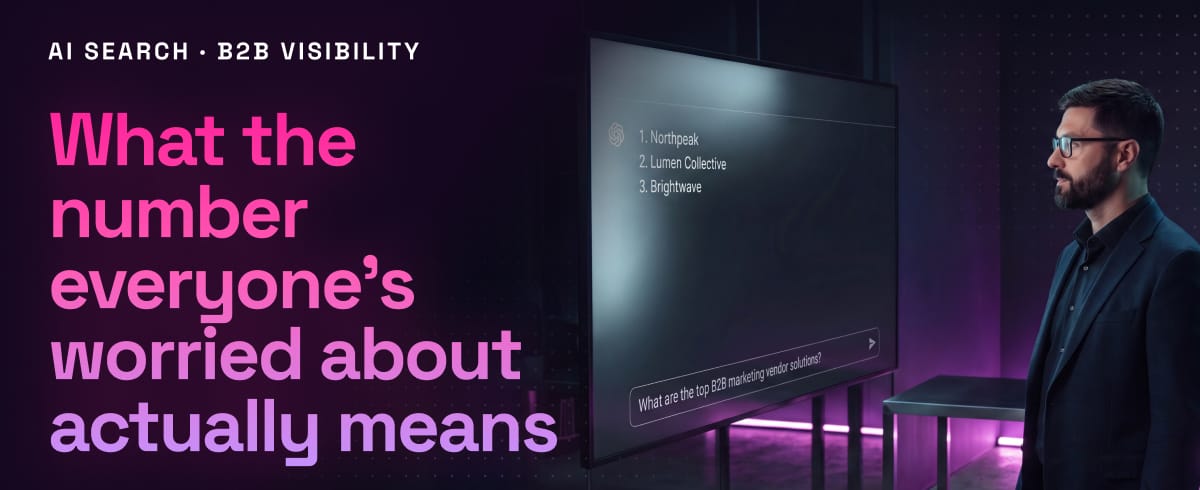
The Non-Vendor Problem: Why Your B2B Brand Is Missing From AI Shortlists
KEY TAKEAWAYS The shortlist happens before Google: Buyers now ask AI tools (ChatGPT, Gemini, Claude, Perplexity) for a shortlist before they ever search — if you’re not on it, you’re not in the conversation. The favourite usually wins:Forrester found buyers pick their vendor shortlist before any seller contact 95% of

The Competitive Advantage of Deeper B2B Funnel Measurement
KEY TAKEAWAYS Most accounts optimise to the wrong thing: 8 in 10 B2B paid accounts audited still optimise to the raw lead, not MQL/SQL/pipeline — which trains ad platforms to find more form-fillers, not buyers. The barrier is organisational, not technical:CRM-to-ad-platform integration isn’t new or hard — most CRMs like
Beyond the Click: How Data Enrichment Drives Revenue and Credibility
KEY TAKEAWAYS Fragmented reporting costs credibility: When paid media, analytics, and CRM all show different numbers, marketing’s credibility with the board erodes. Outcome enrichment aligns systems:Feeding context between systems means everyone tracks the same definition of a conversion, from click to closed revenue. Measure one step deeper:Go from MQL to