CHALLENGES / INVISIBLE TO THE MARKET
Why Your Brand Doesn't Make Noise in the AI Era
THE PROBLEM
Four teams, Four reports and one number that doesn’t add up.
Incoherent signals
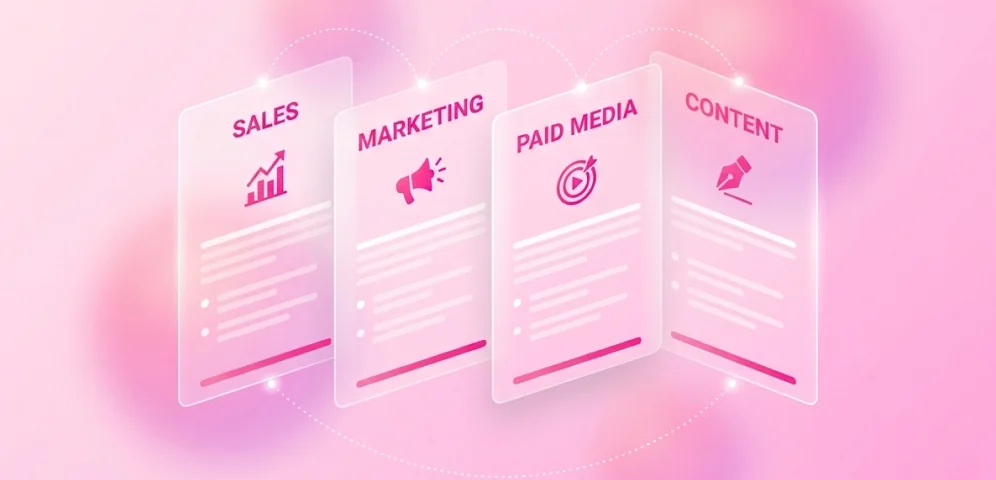
Four channels and four versions of your brand.
You're publishing content consistently, your website is professionally designed, and your paid campaigns are running. But your brand is still invisible where it matters most.
AI reads into the gap
Each piece looks fine alone, but AI can see the contradictions.
The problem isn't effort or budget, but rather your brand's coherence. Your LinkedIn presence says one thing about your company. Your website says something slightly different. Your paid ads emphasize a third value proposition.
Your content team writes from one set of messaging guidelines while your demand generation partner writes from another, or from none at all. Each piece of marketing, viewed individually, looks fine. But when viewed together, as AI engines do, they create confusion rather than authority.
Invisible by default
AI recommends the brand it can read clearly. That's your competitor.
This always mattered for buyers, who form impressions across multiple touchpoints before engaging with sales. But it matters exponentially more now because AI systems are evaluating your brand as a single entity. ChatGPT doesn't look at your paid campaigns separately from your blog content. Perplexity doesn't distinguish between your website copy and your LinkedIn company page.
These systems synthesize everything into a unified assessment. And when the signals they find are contradictory, they do the rational thing: they recommend someone else with a more coherent digital footprint.
01 Incoherent signals
Incoherent signals
Four channels and four versions of your brand.
You're publishing content consistently, your website is professionally designed, and your paid campaigns are running. But your brand is still invisible where it matters most.
02 AI reads the gap
AI reads into the gap
Each piece looks fine alone, but AI can see the contradictions.
The problem isn't effort or budget, but rather your brand's coherence. Your LinkedIn presence says one thing about your company. Your website says something slightly different. Your paid ads emphasize a third value proposition.
Your content team writes from one set of messaging guidelines while your demand generation partner writes from another, or from none at all. Each piece of marketing, viewed individually, looks fine. But when viewed together, as AI engines do, they create confusion rather than authority.
03 Invisible by default
Invisible by default
AI recommends the brand it can read clearly. That's your competitor.
This always mattered for buyers, who form impressions across multiple touchpoints before engaging with sales. But it matters exponentially more now because AI systems are evaluating your brand as a single entity. ChatGPT doesn't look at your paid campaigns separately from your blog content. Perplexity doesn't distinguish between your website copy and your LinkedIn company page.
These systems synthesize everything into a unified assessment. And when the signals they find are contradictory, they do the rational thing: they recommend someone else with a more coherent digital footprint.
WHAT THIS FEELS LIKE
What invisibility actually feels like.
It doesn’t show up on a dashboard. It shows up in the questions sales calls have to answer.
SYMPTOM 01
MISSING FROM THE ANSWER

Buyers ask AI and your competitor appears but you don't.
A buyer researching your category asks ChatGPT for recommendations. Your competitor appears by name because their content is consistent, their messaging is coherent across platforms, and their entity signals are strong enough for AI systems to cite them with confidence.
CONTINUE READING
Your company doesn’t appear not because your product is worse, but because your digital presence is fragmented and AI systems can’t construct a clear picture of what you are and why you’re relevant.
SYMPTOM 02
SHORTLISTED WITHOUT YOU

Pipeline shapes itself before the buyer ever lands on your site.
Buyers are making shortlists before they ever visit your website, and AI is shaping those shortlists. The brands that show up as recommendations in AI-generated responses capture attention at the earliest and most influential stage of the buying process.
CONTINUE READING
The brands that don’t show up start every sales conversation at a disadvantage, if they get one at all.
SYMPTOM 03
EDUCATION BEFORE NEGOTIATION
Prospects arrive less informed about you than your competitors.
Discovery calls require more education. Deals take longer to progress because the buyer hasn't developed familiarity with your brand during the independent research phase.
CONTINUE READING
THE MISDIAGNOSIS
Why “more content" doesn't fix it.
THE INSTINCT
What teams reach for first
- Publish more content
- Refresh brand guidelines
- Hire a creative agency
- Run a rebrand
You can’t brief your way to consistency across four separate teams.
THE REALITY
Why none of it produces coherence.
- LinkedIn presence says one thing
- Website says something slightly different
- Paid ads emphasize yet another value proposition
- Content team writes from one set of guidelines, demand gen writes from another (or none)
When four different partners interpret guidelines independently, the output is a patchwork that looks coordinated from the inside but incoherent from the outside, and AI engines synthesize everything as one signal.
Brand coherence is an operational problem, not a creative problem.
You can’t brief your way to consistency across four separate teams. You need one team producing one coherent signal at every touchpoint.
THE ALTERNATIVE
One team. One signal. One brand.
What changes when your brand speaks with one voice.
Imagine your positioning, content, and creative all informed by performance data, aligned to a single strategy, and executed as part of one integrated operation.
- Your positioning shows up the same way on every platform AI evaluates.
- Your content reinforces a coherent entity signal that earns AI citations.
- Creative is briefed once and deployed consistently across every channel.
- Brand search, content engagement, and conversion all tie back to pipeline.
That’s what brand coherence looks like in practice. And it’s what the Creative Studio component of the Evolution Framework is designed to deliver.
QUESTIONS
Frequently asked questions
Our brand guidelines are comprehensive. Why isn’t that enough to ensure consistency?
Brand guidelines define what the brand should look like and sound like. They don’t control what separate teams actually produce. Most brand guideline documents live in a shared drive that gets referenced at the start of an engagement and then gradually drifts from practice. When four different partners interpret those guidelines independently, the outputs diverge in ways subtle enough to be missed internally but obvious enough for AI systems to detect. Consistency isn’t a document problem; it’s an execution problem.
How quickly can AI visibility improve?
Entity alignment changes, consistent brand information across all platforms, and proper structured data can improve how AI systems perceive your brand within four to eight weeks. Building the content authority that earns citations and recommendations typically requires two to four months of sustained, coherent output. Full competitive AI visibility, where your brand consistently appears when buyers research your category, usually takes six to twelve months to develop. The timeline depends heavily on how fragmented your current presence is and how strong your competitors’ entity signals are.
Is this just a branding exercise?
No. This is about pipeline. Brands that appear in AI recommendations are placed on shortlists earlier. The brands that don’t appear start every sales conversation behind. We’ve seen the gap in discovery calls, deal velocity, and inbound quality. Coherent brand presence converts at higher rates because buyers arrive already familiar with your positioning, which means less education, shorter sales cycles, and higher close rates. The creative work serves the commercial outcome.
We’re already investing in content marketing. Why aren’t we more visible?
Volume doesn’t create visibility, but coherence does. Publishing consistently across channels is necessary but not sufficient. If the content your blog produces contradicts the value proposition in your paid campaigns, or if your thought leadership takes positions that your website doesn’t reflect, the overall signal is muddled. AI systems weigh consistency and authority over volume. Ten coherent pieces of content that reinforce the same positioning will outperform a hundred pieces that send mixed signals.
How do you measure brand visibility in AI systems?
We track AI citation frequency across major platforms (ChatGPT, Perplexity, Gemini, Google AI Overviews), monitor whether your brand appears in category-level and solution-level queries, measure recommendation inclusion against competitors, and assess citation quality to ensure AI systems accurately represent your capabilities. These metrics sit alongside traditional brand metrics and pipeline data in a single integrated view, so you can see how AI visibility connects to commercial outcomes.

Director of Digital Strategy & Client Solutions

Head of SEO
READY TO OPTIMIZE?
Your competitors are visible in AI recommendations. Make sure you are too.
We’ll audit your current brand presence across AI discovery platforms, show you where competitors appear and you don’t, and outline what it would take to build the coherent entity signal that earns AI citations and buyer attention.

Director of Digital Operations

Senior CRO Manager