KEY TAKEAWAYS
-
The favourite usually wins:
Forrester found buyers pick their vendor shortlist before any seller contact 95% of the time, and the pre-contact favourite wins 80% of deals. -
Zero-click isn’t zero-intent:
Zero-click searches (58–62% of all Google searches) are mostly the 95% of buyers doing early research, not the 5% who are in-market now. -
Context beats keywords:
AI search evaluates a rich, well-structured digital presence (content, citations, schema) — that’s what earns you a mention. -
How to fix it:
Invest in category-depth content, third-party citations and PR, technical clarity (schema, structured data), and full-funnel presence rather than bottom-funnel demand capture alone.
There is a version of the B2B buying journey that most marketing teams are still building for, which goes like this: A buyer identifies a problem. They go to Google. They search for solutions. Your ad appears. They click. They convert. Your pipeline grows.
That version of the journey is increasingly fictional.
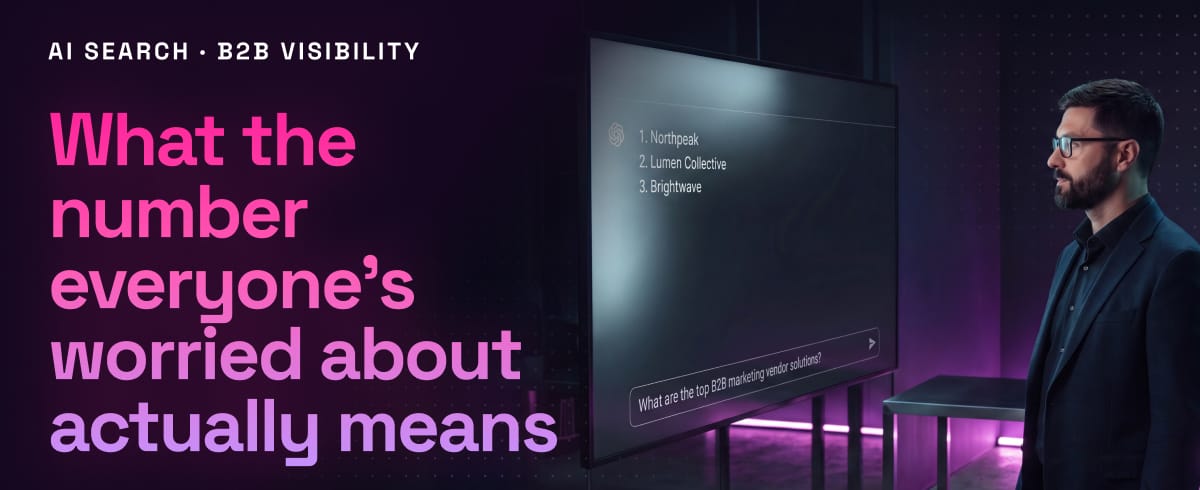
The new version works differently. A buyer identifies a problem. They open an AI tool like ChatGPT, Gemini, Claude, or Perplexity, and ask it to give them a shortlist of solutions. They get three names back, and yours isn’t one of them. By the time the buyer reaches Google, the evaluation has already happened. They’re searching for the companies they were given, not looking for new ones, and the shortlist is closed.
“People will do their research with the help of AI because information has now become a commodity,” says Cristiano Winckler, Director of Digital Operations at Somebody Digital. “Something that used to take weeks can now be done in five seconds. And they will usually shortlist two or three products or services, or known vendors, as we call them, before they even start doing research on Google.”
This is the non-vendor problem, and for B2B companies still allocating the majority of their marketing budget to demand capture at the bottom of the funnel, it is quickly becoming a structural threat.
The Shortlist Is Forming Before You Know It
Forrester’s 2026 B2B Buying Study found that buyers now make their vendor shortlist before any seller contact 95% of the time, and the pre-contact favorite wins the deal in 80% of cases. The proportion of B2B buyers using AI in their purchase process has grown from 89% in 2025 to 94% in 2026. More striking still is that twice as many buyers now name generative AI or conversational search as their most meaningful research source compared to any other source, outranking vendor websites, product experts, and sales representatives.
The implication for B2B marketers is stark. If your brand is not the kind of brand that AI surfaces when someone asks “what are the best solutions for [your category],” you are being systematically excluded from consideration at the stage where buying decisions are being shaped.
And the window for discovery that used to exist, traditionally the organic search result, the LinkedIn ad, the conference sponsorship, is compressing. Not disappearing, but compressing. There is simply less room for a buyer to stumble across you during the research phase when that research phase is happening inside an AI interface.
“We have the effect of what we know as the non-vendor,” says Winckler. “Buyers do their preliminary research, and they’re going to come up with a shortlist of a maximum of three companies, sometimes one or two. If you’re not on that list, you’re not in the conversation.”
Why Zero-Click Doesn’t Mean Zero-Intent
Before diving into the fix, it’s worth pausing on a distinction that matters for B2B specifically. The statistics around zero-click search, between 58 and 62% of searches now end without a click, according to data shared at Somebody Digital’s recent Marketing IQ Live workshops, can look like a catastrophe if you read them the wrong way.
“When we’re saying that 58% of users are getting their answers from the summaries at the top, I don’t think those people were necessarily in-market buyers,” says John Wilkes, Head of Strategy and Co-Founder at Somebody Digital. “The logic that makes sense is that 95% are not in market at the time, only 5% are, and we need to be putting much more time into that 95%. Those who are having their questions answered by the summaries are in that 95% bracket. They’re doing research. They’re not clicking through. They’re getting the answers they want.”
This is an important reframe. The zero-click searches happening at the AI summary stage are largely early-phase research, the kind of exploration a buyer does six months before they’re ready to commit. They are dark social activities. Hard to measure, easy to dismiss, and critically important to the pipeline that shows up two or three quarters from now.
“If you’re not working that traffic,” says Wilkes, “it’s going to affect your pipeline in the next two, three, four quarters.”
The non-vendor problem is not primarily about losing in-market buyers to a Google summary. It’s about not being part of the mental model a buyer is building during the long research phase, the phase where preferences are formed, framings are established, and shortlists get written.
Context Has Replaced the Keyword
Understanding how to solve the non-vendor problem requires understanding how AI search actually works, which is fundamentally different from how keyword search worked.
Google’s own language on this, presented at its Future of Search Summit and echoed across its 2025-2026 product announcements, is explicit: the search box is becoming an AI agent. It is no longer about matching a query to a page. It is about understanding context, predicting intent, and serving answers that are specific to the individual, not just the query.
“It’s no longer about a keyword or a query, it’s about the context behind it,” says Winckler. “Queries are now two to four times longer than original keyword research. Users are having conversations with search. That information is quite important to how you need to think about content.”
The pet-carrier example Winckler uses in workshops illustrates this well: if someone searches for airlines that accept pets, Google doesn’t just return a list of airlines. It infers context; this person is probably traveling with a pet for the first time, they probably don’t have a carrier, and it serves ads accordingly. The advertiser who wins that placement isn’t the one who bid on the keyword “airlines that accept pets.” It’s the one whose full digital presence gave Google enough context to make a confident inference about their relevance.
“Google is going to try to predict your intention, what you’re trying to do, and what you’re going to need,” says Winckler. “Context is unique to you. What that means in practice is that organic results and paid ads will be unique to people.”
For B2B brands, this changes the nature of what content is for. It’s no longer primarily about ranking for a keyword. It’s about building a digital presence rich enough in context (across your website, your thought leadership, your citations in other publications, your structured data)that AI systems can confidently recommend you when someone asks a relevant question.
Being Cited Is the New Being Ranked
The mechanism by which AI search surfaces brands is citation. When a buyer asks an AI for a shortlist of solutions, the AI draws on the sources it has indexed, the content it has processed, and, increasingly, the real-time web it can access. A brand that appears consistently across respected publications, industry conversations, and authoritative content has a higher probability of being cited. A brand that exists primarily as a set of landing pages optimized for conversion has a lower one.
Somebody Digital’s service offering explicitly includes AI Search Optimization (GEO) — Generative Engine Optimization — because the mechanics of earning AI citations are distinct from traditional SEO, even as they build on the same foundations of quality and authority.
“You make a change on a landing page, and not only is it benefiting Google paid search,” says Winckler, “but all other AI engines as well. You make it easier for them to understand what you do, what kind of products or services you offer, and have more context around your company. That gets you to better and more citations. So you make this change, and you follow best practices, you’re actually ensuring you’re following best practice across every other AI tool and AI agent out there.”
The brands that are appearing on AI shortlists right now are, in most cases, the ones that have spent years building depth of content around their category. They have published extensively on the problems their buyers face. They have been cited in industry publications. They have structured their web presence so that a language model can extract clear, unambiguous signals about what they do and who they do it for.
What the 95% Look Like
Because this problem lives primarily in the 95% of buyers who are not yet in-market, it requires a different measurement mindset to address. The question is not “how many conversions did our content generate this quarter?” It is “Are we present in the research journeys of the buyers who will be in-market next year?”
This is genuinely difficult to measure with precision. But it is not impossible to track directionally. Branded search volume trends over time are one indicator. Increases in direct traffic can signal growing awareness. The appearance of your brand in AI-generated responses, which can be tested manually, is becoming a meaningful signal of citation authority.
“We live in a very fragmented marketing environment right now,” says Wilkes. “You might see from a direct revenue perspective that one channel is not converting. But we can see that it is consistently part of the buying cycle. Especially if you’re dealing with B2B, it’s long, it’s complex, and there are often multiple people. When you can stitch those pieces together, it just makes the team so much more effective.”
Getting Off the Non-Vendor List
For most B2B brands, moving from a non-vendor to a known vendor in the AI era is a content and authority problem. The practical priorities look something like this.
- The first is depth of category coverage. AI systems are more likely to cite a brand when that brand has published substantive, accurate, and useful content about the problems buyers are trying to solve. This means going beyond product-centric content and investing in genuine thought leadership around the category.
- The second is citation presence. Being referenced in industry publications, analyst reports, and credible third-party sources builds the kind of signal that AI search draws on when forming shortlists. PR and media coverage, historically seen as brand-building activities, are becoming measurably important to search visibility in the AI era.
- The third is technical clarity. AI systems, including Google’s AI overview, assess your entire digital footprint when deciding whether and how to surface you. Schema markup, structured data, clear product and service descriptions, and a landing page experience that accurately represents what you do; these technical signals matter more than they did when matching a keyword to a meta title was the primary evaluation mechanism.
- The fourth is presence across the full funnel. A brand that only exists at the bottom, in retargeting lists and conversion landing pages, has almost no visibility in the early research phase, where shortlists are forming. Building presence in the 95% means investing in content and channels that reach buyers before they know they’re buying.
“If you focus on demand capture at the bottom of the funnel,” says Winckler, “you will no longer survive. There are more nuances to full funnel execution, but the principle is clear: creative, conversion, and context now have to be part of your whole digital marketing strategy.”
The Window Is Open, For Now
The buyers making shortlists today are using AI tools that are themselves still being trained. The citation authority, the topical coverage, and the presence across trusted sources are assets that compound over time. The brands investing in them now will be harder to displace in six months than they are today.
The brands waiting for the channel metrics to return to normal, or assuming the Google they knew is the Google they’ll have next year, are not just falling behind. They are becoming non-vendors.
Somebody Digital runs Marketing IQ Live every two weeks — a practical workshop for B2B marketing leaders covering the strategies, tools, and frameworks driving modern marketing programs. Join the next session.
It is a structural threat where B2B companies are systematically excluded from consideration because they are not among the few companies recommended by AI tools when buyers conduct their initial research. Since buyers form their shortlists—often just two or three vendors—before ever reaching a vendor’s website or contacting sales, being absent from that AI-generated list effectively removes you from the conversation.
Buyers are using AI tools like ChatGPT, Gemini, and Claude to consolidate weeks of research into seconds. Because information is now a commodity, buyers leverage AI to create a shortlist of solutions before they start “doing research” on Google, where they only search for the specific companies they were already given.
No, a zero-click search often represents early-phase, “dark social” research by the 95% of potential buyers who are not yet in-market to commit. While these users are not clicking through to your site, they are gathering information that will shape their preferences and shortlists months before they are ready to buy; failing to reach them now will negatively impact your pipeline later.
AI search is no longer about matching a query to a webpage; it is about understanding context, predicting intent, and serving answers specific to the individual. Unlike traditional SEO, which prioritizes keyword matching, AI systems look for digital footprints rich enough in context—across websites, thought leadership, and citations—to make confident inferences about a brand’s relevance.
While GEO builds on the foundations of quality and authority found in SEO, it is distinct because the mechanism for visibility is the AI citation. Making changes to improve AI understanding,like optimizing landing pages and structured data—benefits traditional search, but it is specifically aimed at ensuring AI systems can confidently recommend your brand when asked a relevant question.