KEY TAKEAWAYS
-
The click pool is shrinking:
Zero-click searches now make up 58–62% of Google searches, and CTR drops ~46–47% when an AI overview appears — for both channels. -
Google is becoming an AI agent:
It judges content, landing pages, structured data, and ad creative as one system, not a search index. -
Integrate, don’t compete:
Winning teams share KPIs across content, paid, SEO, and web rather than competing for attribution credit. -
Five principles for the new era:
Integration first, full-funnel execution, creative and conversion as core disciplines, AI as a tool (not a replacement for expertise), and unified measurement.
For as long as digital marketing has been a professional discipline, there has been a fight. It shows up in budget meetings, QBRs, and attribution reports. It shows up in the way teams are structured, the way performance is measured, and the way credit gets assigned. It is the paid-versus-SEO debate: which channel is really doing the work, which one deserves the budget, and which team gets to claim the conversion.
That debate is over because AI made it irrelevant.
“Our take here is that the paid versus SEO conversation, although it is important, the debate is kind of over because AI won in the end,” says John Wilkes, Head of Strategy and Co-Founder at Somebody Digital. “It just got pummeled across paid and SEO. It’s the new problem, but the old problem is still there. We just need to come at it from a different angle.”
That different angle isn’t about which channel to fund. It’s about whether your organization is structured to operate in a world where those channels no longer function independently.
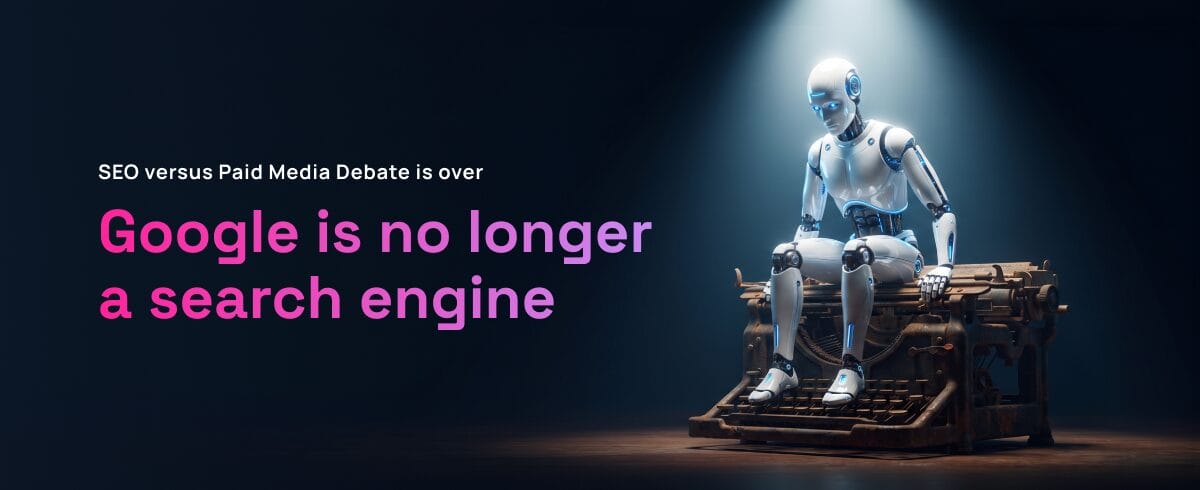
The Typewriter Analogy
Cristiano Winckler, Director of Digital Operations at Somebody Digital, reached for a specific analogy when describing the scale of this shift in a recent Marketing IQ Live session.
“I’m going to give away my age now,” he said. “It was quite normal, when I was a kid, to start going to typewriting courses when you turned ten or twelve. We didn’t have personal computers in our homes yet. If you wanted to work somewhere, the typewriter was one of the main tools for writing reports and letters. Then personal computers came in and completely obliterated that industry. This is the typewriter moment right here.”
It’s worth sitting with that comparison. The typewriter didn’t fade away gradually over a generation. It became obsolete with a specific new technology — the personal computer — and no amount of skill at typewriting helped you adapt to what came next. The people who thrived were the ones who recognized the change quickly and moved.
Winckler is making the same argument about the structure of digital marketing teams, and specifically about the assumption that SEO and paid media can continue to operate as separate disciplines with separate goals and separate reporting lines.
“You could get away in the past with running campaigns in isolation and having that little fight between SEO and paid media,” he says. “Now it’s no longer possible. You need to have multi-channel orchestration as part of your strategy. You need to be able to measure every single touch, including AI.”
What Made the Debate Possible in the First Place
To understand why the debate is now over, it helps to understand why it existed at all.
For most of the 2010s, paid search and organic search operated on parallel but mostly separate tracks. A user would type a query. Google would return results. Paid results appeared at the top, organic results below. Both teams could legitimately claim credit for the conversion because both were contributing to visibility on the same results page.
This created a built-in tension. Was the organic team making the brand famous so that paid could capture the demand? Or was paid to cover the gaps where organic couldn’t rank? The attribution models used to answer these questions were always imperfect, and the arguments about branded paid (whether to bid on your own brand name when you already rank organically) became a perennial feature of marketing planning conversations.
The underlying structure of that argument depended on a world where search worked a certain way: a user types a keyword, a results page appears, and a click happens. That world is changing at speed.
What Has Actually Changed
Zero-click searches now represent between 58 and 62% of all searches on Google. When an AI overview appears in results, click-through rates drop by approximately 46 to 47%. On certain keywords, the drop is as high as 55%.
“More than half of the clicks we had available before have just vanished,” says Winckler. “If you were fighting for 20,000 possible clicks, you’re now fighting for 10,000, probably with the same number of competitors. And we need to remember Google is an auction. If you have the same pool of competitors with a smaller number of clicks, things will get way more expensive.”
The arithmetic here is straightforward and sobering. The same budget, fewer clicks, same or greater competition. The platforms that used to be efficient at their respective jobs, SEO at generating organic traffic, paid at capturing in-market demand, are both operating in an environment where the inventory has shrunk.
But the inventory problem is only part of it. The more fundamental change is structural: Google is no longer functioning primarily as a search engine. It is becoming what Winckler calls an AI agent.
“Google is completely changing the way you imagine search,” he says. “They are calling it themselves: this is the biggest upgrade to their search box in 25 years. Google is no longer a search engine. It’s moving towards an AI agent style of search, providing data and connecting devices, connecting tools. Moving forward, every single search box will be in AI mode.”
In this environment, the separation between paid and organic is less meaningful than ever because the evaluation happening inside an AI search is not a keyword auction. It is a contextual assessment of your entire digital presence: your content, your landing pages, your structured data, your ad creative, your reputation across third-party sources. The AI doesn’t care which team owns which part of that presence, because it evaluates them together.
The Real Problem: Teams Built for a Different World
The practical implication of the typewriter moment is not just that the strategy needs to change. It is the team structure that needs to change.
“Before, you would have one PPC specialist, and that individual could manage the whole thing,” says Winckler. “That was the reality, and you could get away with doing things not 100% properly. That’s no longer the case. If you work in silos and you are not fully integrated with all other departments that compose your digital marketing journey, you will fall behind.”
For Google’s current AI-driven evaluation to work in a brand’s favor, the paid team needs content that actually reflects what buyers are searching for. The SEO team needs landing pages that convert. The landing page designers need to understand what queries are driving traffic. The content team needs to know which topics are generating qualified leads and which are creating noise.
“For the first time in a very long time, small companies actually have an advantage here,” says Winckler, “because they might be ahead of the game for at least some time until the bigger ones adapt. The smaller the company, the easier, specifically if they have lean teams. The larger the organization, probably the slower the change will be.”
For enterprise teams, this organizational challenge may be the hardest part. The paid vs. SEO debate, for all its flaws, gave different functions clear ownership and accountability. The integrated model requires everyone to be measured against shared outcomes, typically revenue or pipeline, and to make decisions in service of that shared goal rather than their individual channel metrics.
“Imagine the following scenario,” says Winckler. “You’re looking at your reports, and you can see that LinkedIn’s conversion rate is 0.2%, Google paid is 1.2%, and Meta is 0.7%. You look at all those numbers and say: The channels that aren’t working well, let’s stop those activities and focus on Google Ads only. That’s the trap. You’re analyzing one channel in isolation. Digital marketing doesn’t work like that. It has not worked like that in a very long time.”
The Five Principles for the New Era
Through their work with clients and their presentations at events including Brighton SEO, the Somebody Digital team has distilled the shift into five operating principles for the post-debate era.
Number one is integration first not just data integration, but organizational integration across content, creative, web, paid, and SEO, all contributing to a single funnel that is evaluated as a whole.
The second is full funnel execution. The bottom-of-funnel demand capture that most paid and SEO programs have been built around cannot carry the entire weight of pipeline growth in a world where bottom-of-funnel clicks are shrinking. Investment needs to move higher up the funnel.
The third is creative and conversion as core disciplines, not afterthoughts. AI-evaluated campaigns place significant weight on ad quality, landing page experience, and the consistency between creative and destination. These are no longer optional elements of a campaign; they are eligibility criteria.
The fourth is using AI as a tool rather than a replacement for expertise. “You can outsource the thinking,” as Winckler puts it, the brainstorming, the generation, the drafting, “but you cannot outsource knowledge.” The specialist who understands the full funnel and can guide AI tools in the right direction is the one who produces the best results.
The fifth is unified measurement. The paid vs. SEO debate was, at its core, a measurement problem. When different teams are measured on different channel metrics, they will optimize for those metrics and compete for credit. When everyone is measured on the same outcome (like pipeline and revenue), the competition becomes cooperation.
“Growth is no longer a metric that belongs to paid media or PPC,” says Winckler. “It’s a metric that belongs to the whole digital marketing department. Because you will need to work together to hit that target.”
What the Typewriter Taught Us
The people who made careers out of typewriting in the 1980s were not bad at their jobs. They were skilled, practiced, and valuable to the organizations they worked in. The problem was not their competence; it was their category. When the personal computer arrived, the skill of typewriting didn’t transfer. The people who thrived were those who understood that the underlying job — clear, efficient written communication — remained necessary, even as the tool changed completely.
The parallel for digital marketers is exact. The underlying job, getting the right message to the right buyer at the right time and being able to prove it created revenue, is still necessary. What has changed is the tool. And the teams that will thrive are not the ones best at paid search or best at organic SEO. They are the ones best at orchestrating the full digital presence that AI now evaluates as a single object.
The paid vs. SEO debate assumed that the two were separate. AI has confirmed that they never really were.
Somebody Digital runs Marketing IQ Live every two weeks — a practical workshop for B2B marketing leaders covering the strategies, tools, and frameworks driving modern marketing programs. Join the next session.
The debate is over because AI has fundamentally changed search, making the historical separation between paid and organic channels irrelevant. AI-driven search environments evaluate a brand’s entire digital presence holistically, rather than weighing keyword auctions in isolation.
Much like the personal computer made typewriters obsolete, AI has introduced a technology shift that renders traditional, siloed marketing team structures obsolete. The analogy serves as a warning: marketing teams that cling to old, isolated methods of operation (separating SEO and paid media) will struggle, while those that adapt to the new AI-driven reality will thrive.
Google is transitioning from a traditional search engine to an “AI agent.” This has led to a significant increase in zero-click searches and a reduction in click-through rates (roughly 46–47% lower when AI overviews appear). Consequently, inventory is shrinking, and costs are rising due to increased competition for a smaller pool of clicks.
Teams must shift away from working in silos. Success in the new era requires:
- Organizational Integration: All departments (content, creative, web, paid, and SEO) must contribute to a single, shared funnel.
- Full-Funnel Execution: Moving investment higher up the funnel rather than relying solely on bottom-of-funnel demand capture.
- Unified Measurement: Measuring success based on shared outcomes, such as revenue and pipeline, rather than individual channel metrics.
No. While AI is a powerful tool for brainstorming, drafting, and generation, it is not a replacement for human expertise. The article emphasizes that you can “outsource the thinking,” but you cannot “outsource knowledge.” The best results come from specialists who understand the full funnel and can guide AI tools effectively.