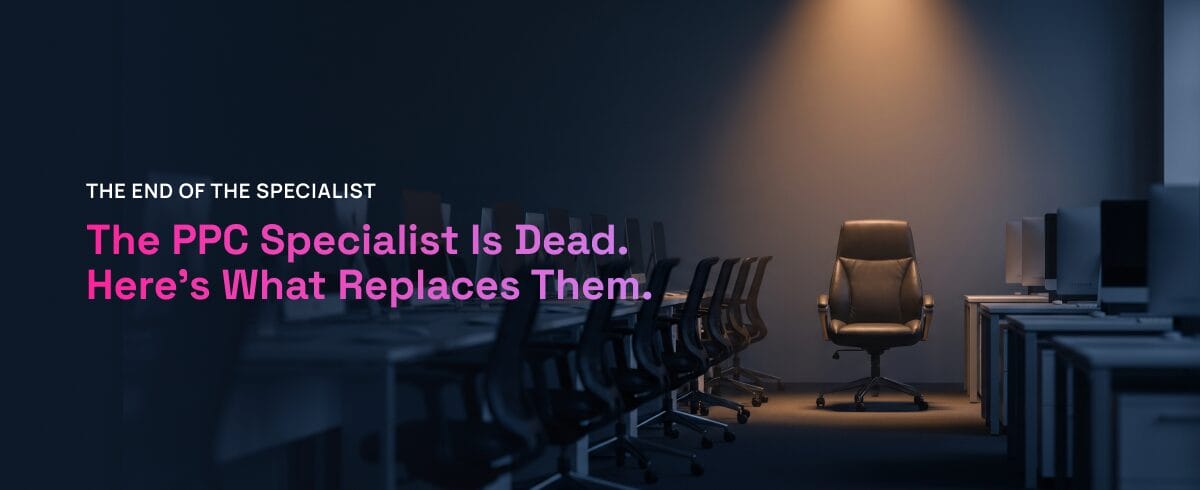
This is not a piece about AI replacing marketers. It’s a piece about something more specific and, for many marketing leaders, more immediately disruptive: the single-channel specialist model that has defined digital marketing hiring for the past 15 years is breaking down. And it’s breaking down now.
“You can’t simply hire a PPC specialist to do everything for you. You will fail,” says Cristiano Winckler, Director of Digital Operations at Somebody Digital. “Those days are gone. Things are about to become way more complex (they are already way more complex). It’s about the whole journey, from user experience to landing page to context, and this is how you need to adapt.”
The PPC specialist was a product of a particular era in digital marketing, one where Google search worked a certain way, where the campaign manager could own the entire paid media journey from keyword research to bid strategy to conversion optimization, and where the results they produced could be evaluated cleanly against a set of channel-level metrics. That era is over.
Why the Single-Channel Model Stopped Working
The change isn’t primarily about AI capability; it’s about how AI is reshaping the environment in which campaigns operate.
Google’s ad platform has been moving toward AI-driven automation for several years. Smart bidding, responsive search ads, and Performance Max each of these represented a progressive transfer of decision-making authority from the human specialist to the algorithm. In each case, the algorithm’s decisions are only as good as the signals it receives, the structure of the campaigns around it, and the context of the landing page it’s sending traffic to.
The most recent shift goes further. Google is now explicitly requiring AI Max or Performance Max campaign formats for inclusion in the AI-driven search results that are increasingly dominating the page.
“For you to be eligible, you need to enable AI Max or PMax campaigns,” says Winckler. “Until recently, six to eight months ago, people were very scared and reluctant about launching these. We had a few clients where we tried tests, and it wasn’t amazing. This is no longer an option. You need to make sure you adapt to what AI Max and PMax require. Otherwise, number one, you’re not eligible to show in AI auctions in the first place.”
The implications of this for the PPC specialist are significant. Running AI Max and PMax effectively requires not just campaign management expertise but the ability to brief creative, shape landing page content, provide context signals, and integrate conversion data from the CRM. These are capabilities that sit across multiple functions. The specialist who could thrive by managing bids and keywords alone cannot do this job alone.
“Google will analyze everything, not just your ad, description, and keyword. It’s about your whole set of ads, including images and videos (like you’re doing full funnel digital marketing), plus the landing page experience. If it’s confusing and if the messaging doesn’t match, you might not be eligible,” says Winckler. “And that might cause a lot of extinction between poorly managed campaigns and the campaigns that always follow high standards.”
The Scope Has Expanded
The scope of what now needs to be coordinated to run effective digital marketing has expanded substantially, and that expansion crosses traditional functional boundaries.
Consider what it takes to run a B2B paid media campaign in 2026. The campaign needs ad creative (images, potentially video) that meets platform quality standards. It needs landing pages with sufficient content depth for Google to accurately interpret what the advertiser does and who they do it for. It needs a landing page experience that is fast, clear, and consistent with the ad creative. It needs CRM integration so that the platform can optimize toward a qualified pipeline rather than raw leads. And it needs SEO-quality content across the broader site to build the contextual authority that AI search draws on when evaluating the brand.
None of these is the job of a PPC specialist alone. All of them need to work together.
“Before, you would have one PPC specialist who could manage the whole thing,” says Winckler. “And when that individual needed something from someone in the company, ‘Hey, I think I need a new landing page, I think we need to increase the content of this landing page, the messaging is off,’ it was not unusual to hear: ‘That’s not us. That’s a different team. They have their own roadmap.’ You could get away with doing things not 100% properly. That’s no longer the case.”
Gartner’s data on buying behavior adds another dimension to this. Buying committees now average 11.2 stakeholders for deals over $50,000. The content that reaches a buyer before they contact a vendor, the blog post, the AI-generated summary, the LinkedIn post, is being consumed by more people, with more scrutiny, across a longer buying journey. The message that the ad team is sending needs to be consistent with the message that the content team is producing, which needs to be consistent with the message that the sales team is delivering. Achieving that consistency requires coordination that no single specialist can own.
What the New Role Actually Looks Like
The replacement for the PPC specialist is not one thing. It is a combination of a new capability model and a new kind of central coordinating role.
“I would say the easiest way is to try to identify your internal champions,” says Winckler. “Every company, every organization will have a couple of individuals who are more curious about this whole AI world. You need to have a strategist who really understands AI, who is able to orchestrate multiple digital marketing disciplines and channels.”
The profile Winckler describes is not a new job title. It’s a new skill set that can and often does live within an existing role. “Perhaps it’s the PPC person you already have in your company, the one who, if you needed to make changes on a WordPress blog article, he’s not a specialist, but he could do that. This is not an SEO person, but they understand the concepts of SEO and what you need to do. They can help with content as well because they understand the types of content that need to be produced. If that person also has knowledge of how to utilize AI and understands the changes, that’s the person who’s going to lead that change internally.”
Three characteristics define this role:
Breadth without dilution. The orchestrator doesn’t need to be a deep specialist in every function. They need to understand how each function contributes to the full funnel, what the dependencies are between them, and where breakdowns are likely to occur. This is a systems thinker, not a generalist.
AI fluency. “You can outsource the thinking,” as Winckler puts it, the brainstorming, the drafting, the generation. “But you cannot outsource knowledge.” The orchestrator needs to know enough about what good looks like in each discipline to evaluate what AI produces and guide it in the right direction.
Revenue alignment. The channel-level metrics, CTR, cost per click, and impression share, are management tools, not success metrics. The orchestrator needs to be comfortable holding themselves accountable to pipeline and revenue outcomes, and needs to be able to communicate performance at that level to leadership and cross-functional partners.
“Growth is no longer a metric that belongs to paid media or PPC,” says Winckler. “It’s a metric that belongs to the whole digital marketing department. Because you will need to work together to hit that target.”
The Team Structure Implications
The emergence of this orchestrating role changes how digital marketing functions need to be structured around it. It also creates a specific challenge for large organizations.
“The larger the organization is, probably the slower the change will be,” says Winckler. “And for the first time in a very long time, small companies actually have an advantage here because they might be ahead of the game for at least some time until the bigger ones adapt.”
In a smaller organization with a lean team, the integrated model is often already partially in place by necessity; the same person who manages paid also writes copy, reviews landing pages, and sits next to the developer. The friction between functions is lower because the functions aren’t that separate to begin with.
In larger organizations with established functional boundaries, the transition requires deliberate organizational change. The paid team, the SEO team, the content team, the web team, and the creative team need shared KPIs, regular joint planning, and a common view of how their work connects to the pipeline.
“The way to get that integrated approach is to have everybody measured to the same KPIs, which is typically revenue,” says John Wilkes, Head of Strategy and Co-Founder at Somebody Digital. “Whether you’re the content team, the web development team, your key KPI is revenue, and you’re all targeted on the same number. So it’s just that simple, new alignment. When you have those QBRs: how is everybody contributing to that revenue? It just shifts the perspective. Because that does not happen in most organizations.”
The Hiring Market Is About to Get Confusing
One consequence of this transition that Winckler flagged directly is worth noting. The new roles that are emerging don’t have established job titles, established salary benchmarks, or established experience requirements. The market is going to try to catch up quickly, and it will make some predictable mistakes in doing so.
“I predict that in a few weeks, we’re going to have a lot of new job titles being produced because of this,” he said. “And then we’re going to have companies that don’t understand, asking for five years of experience in that new job title, which is something that doesn’t exist. So it’s a new skill. But you need to have that champion that has a good understanding of digital marketing workflows as a whole, how the different channels work together for full funnel, multi-channel orchestration.”
For marketing leaders hiring right now, the practical implication is to evaluate candidates on workflow thinking rather than channel expertise. The questions that matter are not “how do you structure a Google Ads campaign?” but “how do you ensure that the ad, the landing page, and the CRM are all sending the same signal to the same algorithm?” and “when the content team and the paid team disagree about a landing page, how do you resolve it?”
The second kind of question is harder to answer from a job description. It is also the kind of thinking that will determine whether AI-era campaigns perform.
What Stays the Same
None of this means that deep channel expertise is worthless. The orchestrator role only functions if there are specialists who understand their disciplines deeply enough to execute at a high quality. SEO still requires SEO knowledge. Paid media still requires an understanding of bidding, quality scores, and campaign structure. Content still requires craft.
What changes is the reporting line of authority and the definition of success. Channel metrics become inputs to a shared measurement system rather than the primary output. Specialists become contributors to a coordinated effort rather than independent operators of their own channels.
The PPC specialist isn’t dead because the work isn’t needed. The work is needed more than ever, and it needs more help than one person can provide.
Somebody Digital runs Marketing IQ Live every two weeks, a practical workshop for B2B marketing leaders covering the strategies, tools, and frameworks driving modern marketing programs. Join the next session.
The single-channel approach, where one individual manages paid media in isolation, is no longer sufficient. Modern marketing requires deep coordination across multiple functions, including creative, landing page design, CRM data, and broader content strategy, to feed the signals AI-driven platforms like Google Ads now require.
The orchestrator is a systems thinker who possesses three core traits: breadth without dilution (understanding how functions contribute to the full funnel), AI fluency (knowing how to guide and evaluate AI-generated outputs), and revenue alignment (holding themselves accountable to pipeline and revenue outcomes rather than just clicks).
Companies need to move away from channel-specific KPIs. Instead, all functions—including SEO, paid media, and web development—should be measured against the same shared goals, typically pipeline and revenue.
Focus on “workflow thinking” over channel expertise. Candidates should be able to explain how to maintain consistency across the entire user journey (from ad to landing page to CRM) and how they handle cross-functional collaboration and conflict resolution.