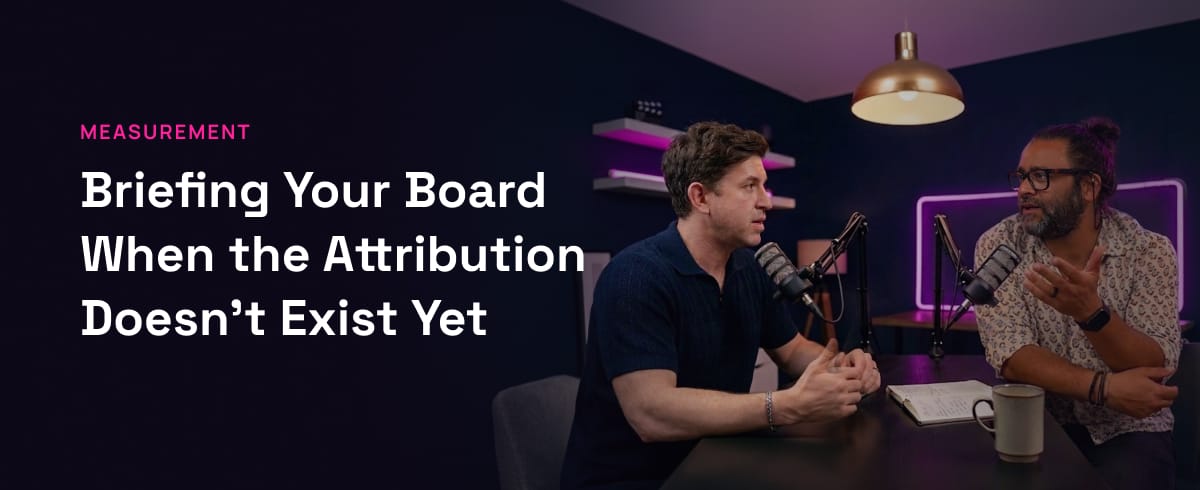
Briefing Your Board When AI Attribution Doesn’t Exist Yet
KEY TAKEAWAYS AI Search Traffic is Undercounted: Much of AI-driven web traffic gets categorized as standard Google Search or “unassigned” due to stripped referrers (e.g., paid ChatGPT, mobile app web views, and AI Overviews). Long-Term ROI vs. Short-Term Attribution: AI authority content functions like brand building; forcing strict quarterly attribution
The Qualifying Detail for AI Overviews that Your SEO Team Used to Cut Is Now Doing the Work
KEY TAKEAWAYS Conversational AI changes how buyers search: Searchers now use natural language with detailed context (e.g., team size, legacy tools, specific pain points) rather than compressed, short keywords. Qualifying details increase AI discovery: Specific context previously cut for having ‘zero search volume’ now provides the surface area needed for

Brand, Non-Brand and Citations: The Search Metrics Worth Reporting Upward
KEY TAKEAWAYS Shift from Non-Brand Rankings to AI Retrieval & Citations: B2B organic search focus is moving from traditional keyword rankings to building brand authority that AI search engines retrieve and cite. Indexing vs. Being Cited: Being indexed is merely a technical prerequisite; getting cited in AI responses requires clear

What to Tell Your Board When Organic Traffic Drops
KEY TAKEAWAYS Traffic drop versus ranking drop: A decline in organic traffic does not necessarily mean your search position has fallen. The ladder analogy: AI Overviews add new content at the top of the search results page, extending the “ladder” above your stable ranking position. AI Shortlisting Potential buyers use
How to Change Board Reporting Metrics Without Moving Goalposts
KEY TAKEAWAYS Shift from vanity metrics: Traditional metrics like organic traffic and form fills are increasingly unreliable due to AI visibility and privacy updates. Add metrics alongside existing ones: To maintain trust with the board, introduce new reporting metrics beside old ones rather than swapping them out entirely. Establish baseline
Give your CRO testing team the authority to be wrong
KEY TAKEAWAYS CRO is high-ROI: Optimizing your existing traffic is the most controllable way to boost revenue quickly across all marketing channels. Committees slow progress: Over-approvals turn quick, low-risk tests into lengthy product-change debates. Expect tests to fail: Most test ideas don’t win; testing on a slice of traffic caps
The leads were too cheap: what we found in a client’s CRM, row by row
KEY TAKEAWAYS Cheap leads are often a warning sign: Extremely low cost-per-lead usually indicates junk traffic, accidental taps, or unqualified audiences that never convert to pipeline. Quality over volume drives real growth: Cutting low-quality lead sources reduces total lead count but dramatically improves MQL qualification rates and overall sales efficiency.
Only about 20% of your marketing can be attributed, so stop selling the rest.
KEY TAKEAWAYS Only ~20% of marketing is truly attributable: Dark social, word-of-mouth, podcasts, and offline interactions drive significant pipeline but cannot be reliably tracked by software. Measure total spend against total revenue: Instead of chasing granular click attribution, track total marketing investment (including tech stack, media spend, staff, and agencies)

Who Should Actually Own AI Adoption in Your Marketing Team
KEY TAKEAWAYS AI can’t replace your specialists: It lacks the judgment, context, and awareness of internal politics that marketing decisions depend on. Compress grunt work, not strategy: AI is best used to compress grunt work (reports, research, data analysis), not make strategic calls. Appoint a champion: Every AI rollout needs

Why Your AI Output Gets Worse the Longer You Use It
KEY TAKEAWAYS It’s a memory limit, not a glitch: AI output quality drops in long sessions because models have a token limit and start silently “forgetting” earlier context. There’s no warning sign:Watch for subtle signs like off-target answers or mismatched details — the model won’t tell you it has lost